


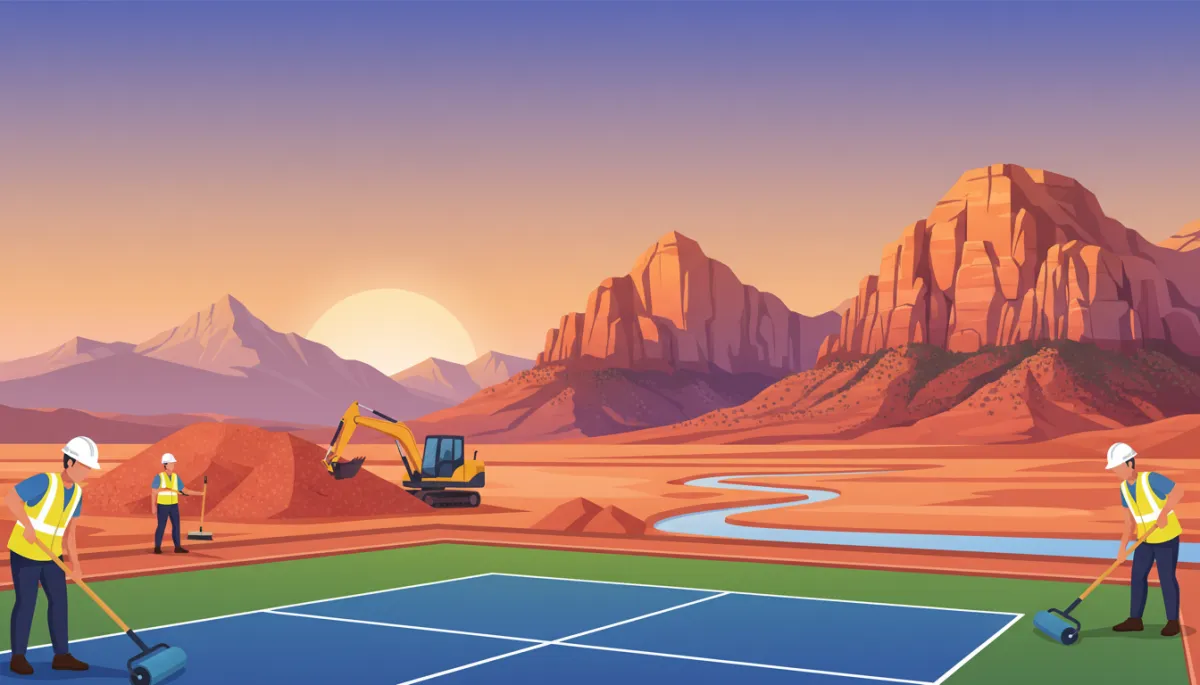
Build a Pickleball Court in Southern Utah
Pickleball, Court Construction, Southern Utah
How Long Does It Take to Build a Pickleball Court in Southern Utah?
If you are dreaming of adding a pickleball court to your Southern Utah property or community, one of your first questions is probably, “How long will this take?” The short answer: most single-court projects in Southern Utah can be completed in about two to three months from shovel in the ground to final striping, assuming good planning and cooperative weather. The long answer depends on where you build, how complex the project is, and how early you start the permitting process.
Typical Timeline: 4–8 Weeks of Actual Construction
Across the U.S., experts estimate that building a pickleball court usually takes around four to eight weeks of on-site work, depending on complexity, site conditions, and weather. Southern Utah projects generally fall in the middle of that range. Local contractors who specialize in backyard and small community courts often quote 4–8 weeks of build time once permits are in hand and crews are scheduled, which aligns with national estimates from industry guides and construction calculators.
Public projects in the region provide useful real-world examples. Monroe City’s Mountain View Park pickleball courts, for instance, are planned on roughly a two‑month construction window—from late July to the end of September 2026. That schedule is tight but realistic for a focused, well-organized build with a clear scope and funding in place.
Phase 1: Planning, Permits, and Design (2–6 Weeks or More)
Before any dirt is moved, you will need to confirm zoning, secure permits, and finalize your court design. In Southern Utah, this step can be quick for a straightforward residential court, or longer for a public or commercial facility with lighting, parking, and multiple courts.
Zoning and land use: Cities and counties across Southern Utah follow Utah’s state construction and land-use codes. You will need to verify that a sports court is allowed in your zoning district and meet any setback, noise, or lighting rules.
Building permits and plans: Local building departments typically require a site plan, grading and drainage details, and structural information for fencing and lighting. For more complex sites, a geotechnical report may be requested to ensure the soil can support a stable playing surface.
Design decisions: Choosing between asphalt or post‑tension concrete, deciding on fencing height, color, and whether to add lighting or seating all affect the schedule and lead times for materials.
For a homeowner working with an experienced local contractor, this planning phase can be as short as two to three weeks. For cities issuing requests for proposals, reviewing bids, and awarding contracts—as seen in Monroe and Escalante—it can stretch over several months, even though the actual construction window remains two to three months.
Phase 2: Site Preparation and Base Work (1–3 Weeks)
Once permits are approved and crews are scheduled, the visible progress begins. Site preparation in Southern Utah typically includes clearing vegetation, rough grading, installing drainage, and compacting a stable base. On a relatively flat, accessible lot, this portion might take five to ten days. On sloped or rocky terrain—common in desert landscapes—it can extend to two to three weeks, especially if retaining walls or additional drainage are needed.
💡 Pro Tip: Good drainage and base preparation are non‑negotiable in Southern Utah’s intense sun and occasional heavy storms. Investing extra time here can prevent cracking, puddling, and costly repairs later.
Phase 3: Surfacing, Curing, and Color Coating (2–4 Weeks)
After the base is in, your contractor will place the playing surface—usually asphalt or concrete. This is a fast step in terms of work hours, but curing and coating introduce built‑in waiting periods. Concrete courts, in particular, require adequate curing time before color coatings and line striping can be applied. Industry guidance and resources like USA Pickleball recommend allowing sufficient cure time and using sport‑specific coatings to achieve proper ball bounce and long‑term durability.
In Southern Utah’s dry climate, curing can be efficient, but extreme heat may require early‑morning work windows and careful moisture management. Expect two to four additional weeks from the day the slab is poured to the day the final color and lines are complete, depending on material choices and weather.

Proper curing and coating add days but dramatically extend the court’s lifespan.
Phase 4: Fencing, Accessories, and Final Touches (1–2 Weeks)
With the surface complete, your contractor will install posts, nets, fencing, and any optional amenities such as lighting, benches, or wind screens. For a single court, this stage is usually wrapped up within one to two weeks, assuming materials are on site. Lead times for specialty fencing or LED sports lighting can extend the overall schedule, so it is wise to order these items early in the process.
How Southern Utah’s Climate and Regulations Affect Your Timeline
Southern Utah’s high‑desert climate is generally favorable for outdoor construction, but it does shape the schedule. Summer heat can limit mid‑day work and affect curing, while rare storm events may briefly delay paving or coating. On the regulatory side, Utah’s adoption of updated building codes and geotechnical requirements means your contractor may need to coordinate with engineers or submit additional documentation, particularly for larger public projects.
The good news is that state law now requires jurisdictions to issue permits when plans meet current codes, which helps keep well‑prepared projects moving. For homeowners or HOAs, partnering with an experienced local installer who understands both the climate and permitting landscape is often the fastest path from idea to playable court.
Putting It All Together: A Realistic Timeline for Your Court
Planning, design, and permits: 2–6+ weeks
Site prep and base construction: 1–3 weeks
Surfacing, curing, and color coating: 2–4 weeks
Fencing, net systems, and accessories: 1–2 weeks
In practice, some of these phases overlap, and experienced crews work efficiently around weather patterns. That is why many Southern Utah projects land in the two‑ to three‑month total window from the first day of construction to the first serve, provided permits and design are finalized before work begins.
Ready to Start Your Southern Utah Pickleball Project?
If you are serious about adding a court in 2026, the most important step is to start early—especially on planning and permits—so your contractor can take full advantage of Southern Utah’s long building season. For region‑specific guidance, product options, and scheduling, reaching out to a local specialist is the best way to get an accurate timeline tailored to your property and goals. To discuss your project and next steps, contact Ace Coatings South and explore what is possible on your site.
