


Thinking About a Concrete Pickleball Court? Read This First
Ever played on a court where a crack sends the ball skidding sideways or a puddle sits stubbornly in the kitchen after a light rain? Those frustrating experiences almost never come down to paint or line striping. The real difference between a mediocre court and a great one is the engineering beneath your feet. A properly built concrete pickleball court starts with the foundation, and that foundation determines bounce consistency, player safety, and how the court performs five, ten, or even twenty years down the road.
If you’re considering building a court at your home, HOA, school, or sports facility, understanding how professional courts are designed—and what can go wrong when shortcuts are taken—will help you make informed, cost-effective decisions.
Concrete Pickleball Court vs Asphalt: Performance, Longevity, and Cost
Choosing the right surface is one of the most important decisions you’ll make when planning a court.
Pros and Cons of a Concrete Pickleball Court
Advantages
True, consistent ball bounce due to concrete’s rigidity
Superior durability with minimal surface deformation over time
Lower long-term maintenance costs compared to asphalt
Ideal base for acrylic sport coatings, which bond better to concrete
Disadvantages
Higher upfront installation cost
Requires precise construction to avoid drainage or cracking issues
Permanent structure, making corrections more involved if installed improperly
Asphalt courts may look fine initially, but they flex with heat and moisture, often developing low spots, surface waves, and puddles over time. Concrete, when engineered correctly, aligns more closely with competitive play standards and surface recommendations promoted by USA Pickleball.
The Engineering Behind a Professional Concrete Pickleball Court
A court that looks great on day one but fails after a few seasons usually suffers from poor preparation. High-quality courts are built as engineered systems—not simple slabs.
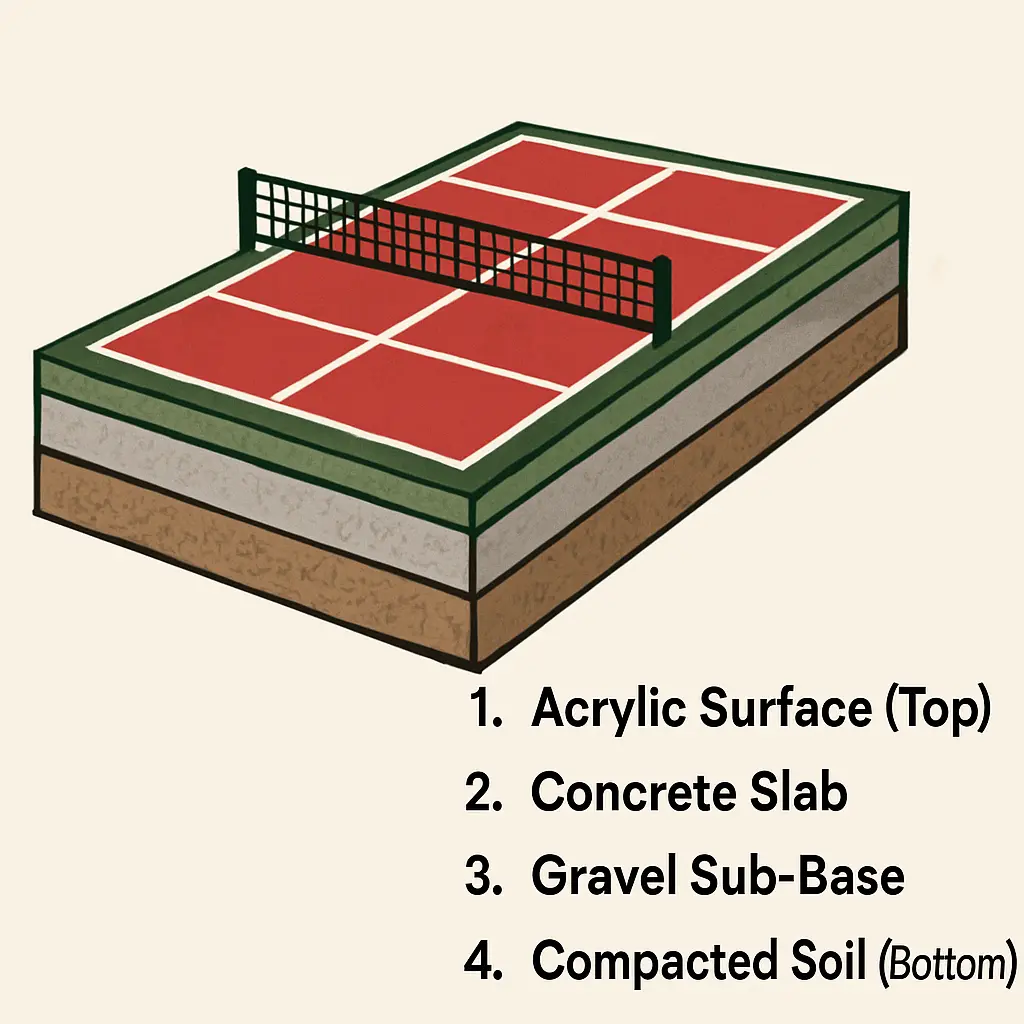
The 4-Layer System That Makes a Concrete Pickleball Court Last
Compacted gravel sub-base
This foundational layer provides stability and allows water to drain away from the slab, reducing soil movement and freeze-thaw stress.Reinforced concrete slab
A residential court typically uses a four-inch slab, properly finished and reinforced to support long-term play.Acrylic resurfacing system
Multiple layers improve durability, texture, and weather resistance while ensuring consistent bounce.Textured color coats and line striping
Silica sand is blended into the coatings to provide safe traction and confident footwork.
Skipping or minimizing any of these layers often leads to premature cracking and uneven play. This is where experienced specialists like Ace Coatings South focus on preparation and system design rather than cosmetic shortcuts.
How to Prevent Cracks and Puddles on a Concrete Pickleball Court
Cracking and standing water are not unavoidable—they are symptoms of improper design.
Reinforcement Methods for a Concrete Pickleball Court
Steel rebar grids help control cracking by holding the slab together
Post-tension concrete systems compress the slab using steel cables, dramatically increasing crack resistance
Post-tensioning requires higher upfront investment but often reduces lifetime repair costs, especially in climates with expansive soils.
Drainage, Slope, and Curing: Where Most Courts Fail
A court that appears perfectly flat will trap water. Professional builders engineer a subtle one-percent slope—roughly one inch of fall for every ten feet—to move water off the playing surface without affecting play.
Equally critical is curing time. Concrete must cure for approximately 28 days before acrylic coatings are applied. Rushing this process traps moisture and leads to bubbling, peeling, and early surface failure.
This attention to detail is why contractors like Ace Coatings South emphasize climate-specific reinforcement, proper slope design, and strict curing timelines to protect your investment.
Can an Existing Slab Be Turned into a Concrete Pickleball Court?
In many cases, yes. Existing patios, driveways, or old basketball courts can often be converted if the slab is structurally sound.
The process typically includes:
Structural evaluation
Crack repair using flexible fillers
Surface grinding and leveling
Installation of a professional acrylic coating system
Resurfacing costs significantly less than new construction and can still deliver professional-grade performance. Ace Coatings South regularly helps clients determine whether resurfacing or rebuilding offers the best long-term value.
Why Surface Coatings Matter More Than Paint
Generic porch paint is not designed for sports performance. Professional pickleball courts use specialized acrylic systems engineered to:
Create reliable traction
Deliver consistent ball response
Resist UV exposure and weathering
These systems are applied in multiple stages, from filler coats to textured color coats, producing the uniform, tournament-quality surface players expect.
Is a Concrete Pickleball Court Worth It?
A concrete pickleball court offers unmatched consistency, durability, and long-term value when built correctly. While the upfront cost is higher than asphalt, the reduced maintenance, superior playability, and extended lifespan often make it the smarter investment.
Working with experienced professionals ensures the court is engineered—not just installed. Ace Coatings South brings the technical expertise, materials knowledge, and proven process needed to build or resurface courts that perform reliably year after year.
Ready to Build or Upgrade Your Pickleball Court?
Whether you’re planning a brand-new court or evaluating an existing slab, expert guidance early in the process makes all the difference.
Contact us at Ace Coatings South to discuss your project, explore surface options, and take the first step toward a pickleball court that plays as good as it looks.
